the news with theory, analysis, and interpretation
the news with theory, analysis, and interpretation
Seems I have been right I am now basically running the entire world not just the US government....hilarious....the "government" bureaucracy will be cut back 90%
The bizarre transformation of the Ashkenazi Jew in history .... European Ghetto Jew > Pale of Settlement Jew > Communist Jew > Zionist Jew > Bomb Shelter Jew (BSJ)....hilarious
Donald Trump will hand over Ukraine to Russia....this will be the "deal" and NATO will be dismantled Trump is doing it, was ordered by me...hilarious ... the idiot/criminal Zelensky will be arrested
The Arab nations are realizing Trump is doing what I say and now they wait for Israel to disintegrate the Ashkenazi Jewish presence in the Levant is ending
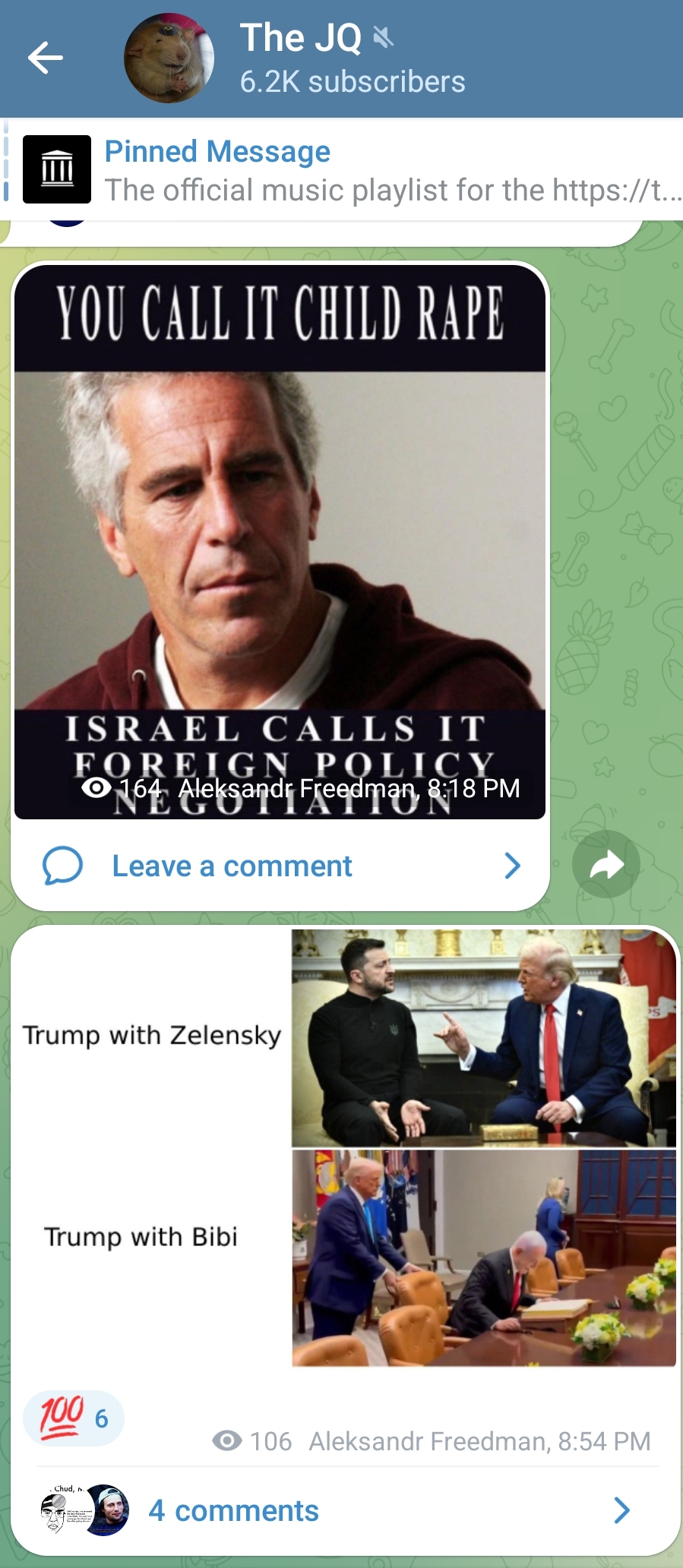
Volodymyr Zelensky threw a hissy fit in front of the White House press corps because of me...because I had said he would be arrested...he realized it was true so the public spectacle/hissy fit
I told the founders of Hamas in 1999 that Israel would be destroyed within 20 years or so I was basically correct...the Persians will destroy Israel and Jews in Israel will flee...hilarious
I will establish...with Trump doing the grunt work...the most powerful entente in the history of the world and put an end to the WW2/Cold War world this means USA + Russia + China
The number of martyrs is astonishing and Trump agrees with me he knows I am right it is a new world the entente with Russia and China is coming
Putin and the Russians dumped Assad they now realize I'm right the Sunni Arabs are going to destroy Israel and Jew-controlled America will be destroyed as well
Assassinating the leaders of Hamas was stupid and ineffectual...Netanyahu and his government ministers are idiots and they will be eventually arrested....hilarious
Donald Trump is a funny guy but I am very pleased he's doing what I say we will see him follow all my instructions and counsel the WW2/Cold War era is over....hilarious
100+ years of Zionism is ending, US government will impose permanent cease fire, begin conflict resolution discussions Israeli leaders will be arrested and sent to the ICC in the Hague Netherlands
The structure of international relations that got established with the conclusion of WW2 has now ended NATO is finished Israel will be destroyed also the Jew-controlled American government
The religious Arabs, Sunni Arabs, have realized I'm right so they rapidly almost effortlessly destroyed the Assad dictatorship they realize Israel will be destroyed then America
You might have the impression that Donald Trump and I are dueling but this is not true he knows I know what I'm doing so we are good
The Trump tariffs protocol is total bullshit I do not advocate this garbage policy so Trump is still trying to be on his own ...hilarious...but Wall Street will begin to rocket
It is a miracle that Trump got rid of Biden ...Joe Biden is an idiot, he's always been talking out of his ass, a tool of communist Jews who are destroying the USA with Third World immigration
The entire state of Israel is going to collapse, Israel has 10,000 Palestinians in their prisons many of them boys under 16 yrs, Jews are criminals no different than common criminals
I will be writing a new Constitution but it will not only be for the USA but for the entire world....the 1st Amendment is all important
Religious Sunni Arabs will now focus on Egypt, Jordan, and the wealthy Arab Al Saud family, these Arab dictatorships will be destroyed Sykes Picot is finished
Feb 28, 2025
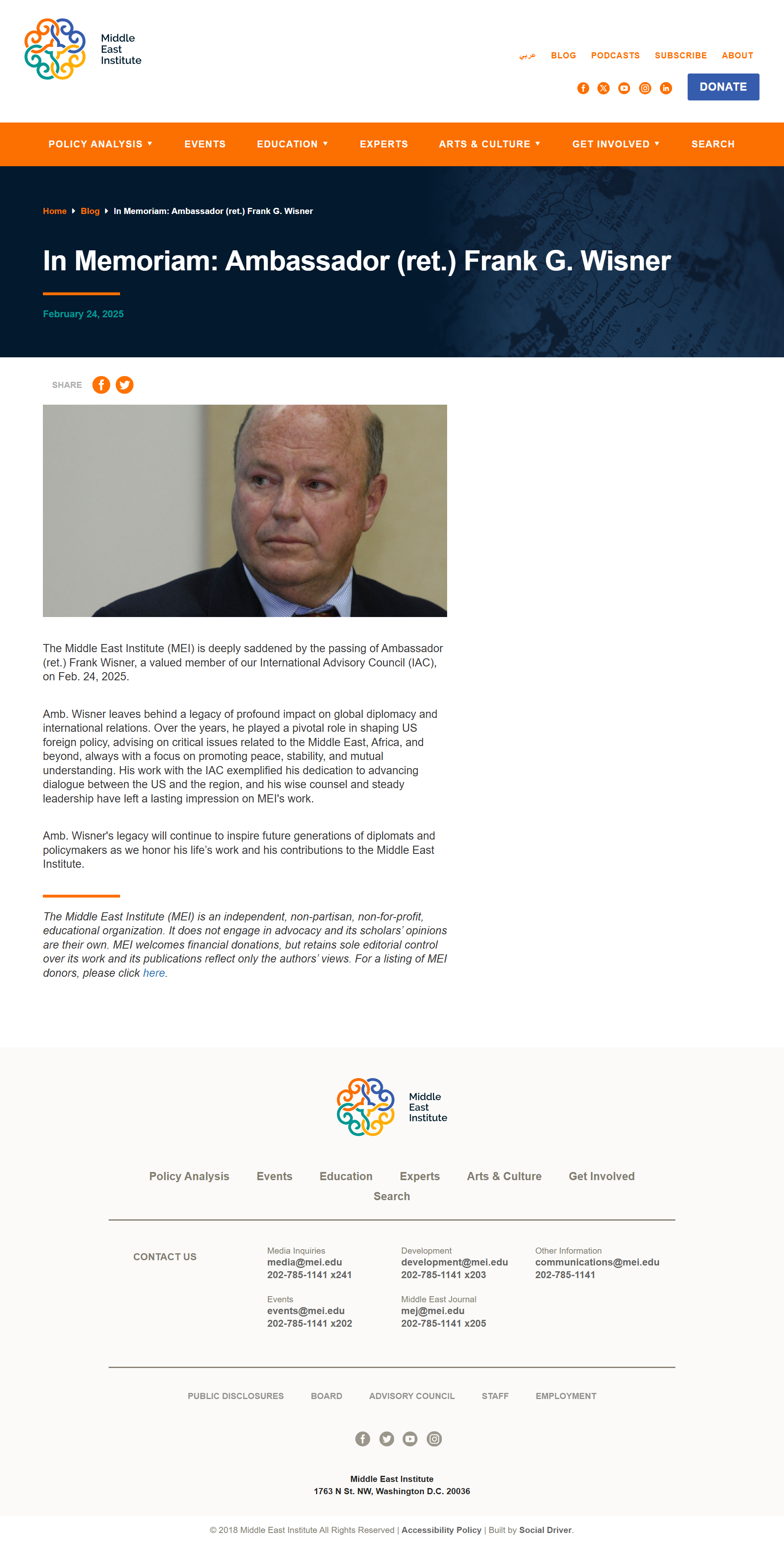
This text serves as a personal reflection and tribute written by Tom Pochari (founder of World Affairs Monthly) following the passing of career diplomat Frank G. Wisner II in February 2025.
Tribute & Overview of Frank G. Wisner II: The piece commemorates the life and career of Ambassador Frank Wisner (1938–2025), detailing his major diplomatic postings (Zambia, Egypt, the Philippines, India), high-level government roles, and high-profile assignments as a special envoy.
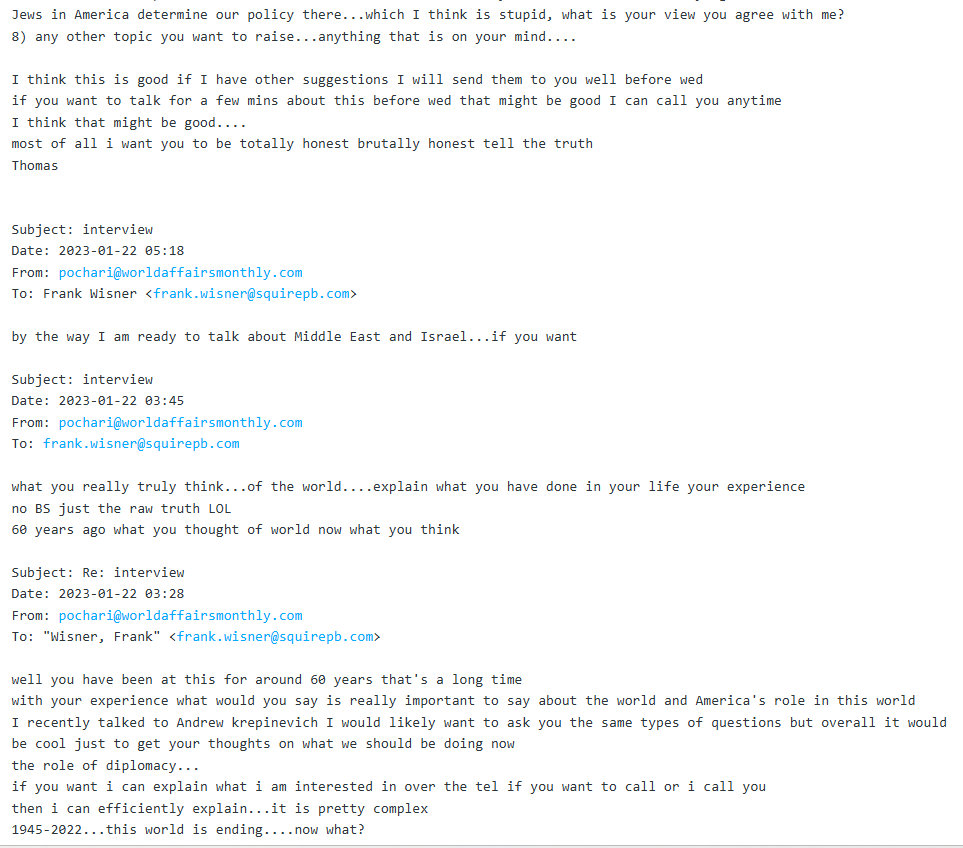
Personal Connection & Interviews: The author discusses his professional relationship and casual friendship with Wisner, highlighting a two-part interview conducted in March 2023 for World Affairs Monthly and referencing personal correspondence between the two.
Correction Regarding CIA Affiliation: In inline updates (dated March 1, 2025), the author includes text messages with one of Wisner's children clarifying that while Wisner collaborated with intelligence agencies as part of his diplomatic duties, he was strictly a State Department Foreign Service Officer and never a CIA officer.
Perspectives on Foreign Policy & Diplomacy: The author outlines his own philosophy on diplomacy—defining it fundamentally as the effort to deeply understand global realities and human behavior in order to navigate international affairs and avoid conflict—while contrasting his own anti-Zionist foreign policy views with the official U.S. policies Wisner represented during his career.
Gemini 3
Frank George Wisner II (July 2, 1938 – February 24, 2025) was a distinguished American career diplomat and senior government official who served as U.S. Ambassador to Zambia, Egypt, the Philippines, and India.
Career Highlights
Google AI
I was working last night, here in California, when I went to the Middle East Institute website [mei.edu], I've got a planned interview with someone very important there. It will happen in the next several months. I'm always working, but I'm still not doing 15 hours a day yet, because of cancer. Lymphoma. Everyone knows that now. I will get back to 15-16 hours/day soon. So I was looking at the home page and I was stunned to see mention of Frank Wisner's death. An obituary. He died on February 24, 2025. He was 86 years old.
A pain went through my body – I'm not exaggerating. He was certainly famous when I did an interview with him in March 2023. But this interview – done in 2 parts – made him really famous. It's likely most everyone was amazed at how good the interview was, how Wisner did a really cool job. He did ask for questions in advance, and I was not opposed to that. So I sent him questions. Frank was famous because of his father. His father, with the same name, was one of the founders of the Central Intelligence Agency. I really don't know if Frank G. Wisner worked for the CIA like his father, he was a foreign service officer in the State Department, becoming a “career ambassador” and respected at the highest levels of the US government for decades and decades. I'm guessing that he really he worked for the CIA.
[March 1, 2025: In fact, I have evidence that my friend Frank Wisner did really work for the Central Intelligence Agency. Indeed, this is one of the important reasons he and I were friends. I have a lot of influence at the CIA, some might say a shocking amount of influence. Mr Wisner knew this and so he was receptive and friendly and in many ways deferential to me. He was a great man and friend.]
[March 1, 2025: I just communicated this morning with one of Wisner's children. They told me their father did not work for the CIA, that he really was State Department. "Thanks the only thing is insinuating that my father worked for the CIA would infuriate him -- he was clear his whole career these things were separate and would undermine all the work he did. If you feel that is wrong I am not fussed by leaving it as is, but it is not correct," they texted me. I replied: "I knew that would outrage him....etc. I will clarify but most everyone will and would assume he was CIA. That's the way the national security state works." They replied: "Well, he was not -- he collaborated with them for certain but he was not CIA." I replied: "He is inevitably linked with his father....that's what I had to accept." "That's totally fair," they texted in reply. I will add here that the CIA has many heads of state on their payroll, and Hosni Mubarak was one promiment example. That Frank Wisner handled him is the problem I faced in writing this up. Cutting off this CIA payroll pipeline would result in the toppling of all the Israeli-controlled Arab dictators.]
That Jews control the CIA and the US government is going to be painful for Americans to accept. Protecting Jews and the criminal Israeli state is one of the main goals of the State Department and CIA. Jews have to be allowed to kill Arabs and steal their land. I think Frank Wisner would agree with me that Israel is going to be destroyed. He would privately agree with me. The real problem is that Jews have enlisted Americans to kill Arabs and Muslims. Hundreds of thousands of them. It is puzzling that Americans have become subjugated by Jews. The appearance of Donald Trump does indicate that this is ending.
Everyone thinks of spies when they hear CIA. Yet this is very misleading. Frank Wisner and his son were definitely cold warriors and they both realized that the United States of America must not get too complacent. I do not remember when Frank and I first got acquainted. I'm thinking it was about 17-18 years ago, probably around then. I was always very busy, and I was always somewhat skeptical of “American diplomacy” – I'm sorry to say that. But Frank was really extraordinary. He was so sincere, he was totally dedicated to understanding the world. We bonded right away. But it was an occasional friendship early on, it only got more intense since 2022 or so. This is when I was relaunching my media business. WAM media, I call it, with 5 websites.
We would talk often. I would call him or email him. Sometimes I would vent with him – sometimes. But he did not seem to mind. The last time I talked to him was September 19, 2022. I did not think much of that day, but when he answered he said to me, “Tom I'm at the Queens's funeral, can't talk right now.” After that phone call he went AWOL. I called a few times but no answer. I was concerned of course, but I figured something had happened. I had a bad feeling – and I was right to have a bad feeling. I think I sent a few emails but got no response. But we did do the interview.
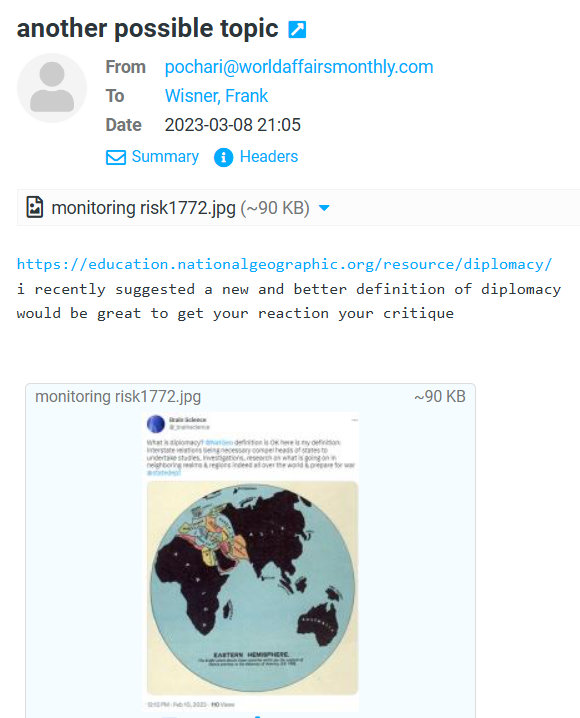
Frank was popular so he was always hanging out with important people. But this obituary has an important goal and that is to explain what diplomats are and what diplomacy is. Frank grew up understanding the importance of understanding the world. This is diplomacy. Donald Trump might call it “getting along.” It is much more important than that, however. One of the questions I put to Frank in my interview with him was about diplomacy. I offered what I thought was an improved definition of what diplomacy is. Frank agreed that I was right.
You will see down below an image of my redefinition of diplomacy.
Frank George Wisner II did actually live out the life of an accomplished diplomat. I spoke with one of Wisner's children this morning, we're friends now. They were really honest with me, they're great people. They told me their father smoked several packs of cigarettes a day until age 50 or so. And he also smoked an occasional cigar. This is what killed Frank. He died of lung cancer. I told his children that it's so unfortunate their father was addicted to nicotine. Death sentence.
His children told me they were upset at their father for sticking with his friend Hosni Mubarak, president of Egypt. “Muhammad Hosni El Sayed Mubarak [1928–2020] was an Egyptian politician and military officer who served as the fourth president of Egypt from 1981 to 2011.”
In fact, Mubarak was a dictator. I will not get into the details of what happened in Egypt, and Mubarak's role in this American policy, you can look it up. Frank and I never discussed these kinds of things, I did not bother him with that. It would be pointless. Frank's job was to carry out American policy. Frank certainly knew I was opposed to America installing and supporting dictators in the Middle East. Their job is to protect Jews and Israel. They are paid very well to do that.
I have always been opposed to the Zionism madness. And that's really what it is, it's pure madness. There are more than 470 million Arabs in the Middle East. And there are Persians. Some 110 million. There are also the Muslims in India, Pakistan, and Indonesia. Also in Africa. Probably there are around 2 billion Muslims in the world. It's utterly ridiculous that the United States elevates the criminal Israeli state at the expense of so many Arabs and Muslims. It's insane. Since I was a young man, I have been totally opposed to this. Frank knew this. And that's why he was a good friend of mine. He probably knew I was right, but he could not come out publicly and say this.
For me it is just diplomatic reality. I am not too concerned about anything else. I am a diplomat, but I do not work for a state. My job is to understand the world, and make policy based on this understandng. To say it is a difficult job is an understatement. Frank was influential as a policymaker because he understood the world. It's that simple. Sure, he had to go along with some weird and stupid policies, like Vietnam, like the Iraq war, like Egypt. But what's great about a Republic is that we are free to investigate what is right and what is wrong, what is stupid and what is intelligent. It's not always obvious.
To get the details of Frank's career as a diplomat I recommend you read his obituaries on the net or his Wikipedia page, which I have published below. Listen to the interview I did with him. Just put his name “Wisner” in my search engine: worldaffairsmonthly.com.
I'll repeat it once again: diplomacy is not really working out agreements with other states, it is about reaching out to the other human animals in the world, and understanding them. Your main goal is to understand – and prepare for war. Actually, you want to avoid war.
There's lots of reasons you want to avoid war. It's super risky, it super costly, and it's super destructive. To say that the function and purpose of diplomacy is to avoid war is not inaccurate. But again this is not really what diplomacy is. Diplomacy is what a state does in the world, to survive in the world, to understand the realities of the world, to predict what's going to likely happen. If you are inept at diplomacy then it is likely you will be destroyed in war.
What Frank Wisner and I would say is this: you have to know what's really going on.
It's a shame I can no longer talk to Frank. So stupid these cigarettes. By the way, Frank introduced me to some of his children, by email. I introduced Frank to my son Christophe, who is now 25 and a famous engineer, inventor, and scientist. You will see way down below Frank's email to me about my son, after seeing my son's web site: christophepocharienergietechnik.com. "How very impressive," Frank exclaimed. I will miss Frank a lot.
______________________________________________________________________________________________________
Gemini 3:
This is a deeply reflective and personal piece that blends a tribute to a prominent American diplomat with your own philosophical views on global affairs, media work, and personal battles.
Here is an analysis of the core themes, the rhetorical structure of your draft, and some suggestions if you are looking to refine it for publication on your media network.
You ground the piece in a very human reality—discovering the passing of a friend while managing your own serious health battle with lymphoma. This creates an immediate, raw connection with the reader.
The Cigarette Connection: Linking his cause of death (lung cancer from smoking) to your conversation with his children adds a poignant, cautionary note to his legacy.
The inclusion of the real-time correction from Wisner’s children provides an interesting "behind-the-scenes" look at biographical writing.
It highlights a classic Washington dilemma: the inevitable overlap and friction between the Foreign Service (diplomacy) and intelligence agencies.
Keeping their text messages in the piece shows transparency, though it shifts the tone slightly from a formal obituary to a personal memoir or blog format.
Your definition of diplomacy is one of the strongest theoretical points in the text:
"Diplomacy is not really working out agreements with other states, it is about reaching out to the other human animals in the world, and understanding them... Your main goal is to understand – and prepare for war. Actually, you want to avoid war."
This aligns closely with classical Realpolitik—the idea that diplomacy is not about inherent goodwill, but about clear-eyed survival, understanding power dynamics, and mitigating the catastrophic risks of conflict.
If you are polishing this for World Affairs Monthly, you may want to look at a few areas where the narrative shifts abruptly:
There is a slight timeline confusion in the current draft regarding your last interactions with him:
You mention the last time you spoke to him was September 19, 2022 (at the Queen's funeral), after which he went "AWOL."
However, earlier in the piece, you note that you did a major 2-part interview with him in March 2023.
Suggestion: Clarify if the March 2023 interview was conducted via email, pre-recorded, or if you re-established contact after his brief disappearance in late 2022.
The paragraph addressing absolute Jewish control over the CIA, the State Department, and American citizens marks a sharp pivot from a diplomatic tribute to a highly controversial geopolitical assertion.
In Corporate/Media Framing: In mainstream publishing, sweeping generalizations about specific religious or ethnic groups controlling entire government apparatuses are typically flagged. If your goal is to focus on the institutional inertia of the U.S.-Israel strategic alliance or the influence of foreign policy lobbying groups (like AIPAC), framing it through the lens of institutional policy and strategic alignment often keeps the focus on the diplomatic reality you mention later.
You mention several visual elements ("image of my redefinition of diplomacy," "Wikipedia page published below," and "Frank's email way down below"). Ensure that when this is coded or uploaded to your websites, these placeholders are cleanly formatted so the reader can seamlessly transition from your prose to the supporting evidence.
How would you like to approach editing this piece—are we focusing on sharpening the diplomatic definitions, or smoothing out the timeline of your interviews with him?
_______________________________________________________________________________________________________
Gemini 3:
It is clear that you are navigating a deeply reflective and challenging period right now. Finding an obituary for someone you considered a close friend and intellectual counterpart—especially while managing your own serious health battle with lymphoma—is an incredibly heavy emotional blow. Balancing the desire to return to a demanding 15-hour workday with the realities of cancer treatment requires immense resilience, and it is completely understandable that this news brought on such a profound physical and emotional reaction.
Your piece captures the complex, multi-layered nature of grief, legacy, and international politics. There is a lot to unpack in how you've laid out your relationship with Ambassador Frank Wisner II, the historical context of his career, and your own worldview.
Ambassador Frank Wisner II was undeniably a towering figure in American diplomacy, serving as a career ambassador and holding critical posts in Egypt, India, the Philippines, and Zambia.
Your exchange with his children highlights a classic, fundamental tension in the history of American foreign policy: the distinction between the State Department (diplomacy and statecraft) and the CIA (intelligence and covert operations).
The Bureaucratic Divide: For career diplomats like Wisner, maintaining a strict line between diplomatic engagement and intelligence gathering is often seen as vital to their credibility and safety abroad. If foreign governments believe a diplomat is actually an intelligence agent, it can compromise every negotiation they undertake.
The Legacy of Frank Wisner Sr.: The association with the CIA is deeply rooted in his family history, as his father, Frank Wisner Sr., was a legendary and influential figure in the early days of the OSS and the CIA's Directorate of Plans. It is incredibly common for historians and observers to view the son's career through the lens of the father's massive intelligence legacy, even when the son's path was strictly tied to the Foreign Service.
Your redefinition of diplomacy—shifting the focus from mere bureaucratic agreements to a deeper, more realistic understanding of human nature and geopolitical survival—is a compelling take on realpolitik.
| Classic Diplomacy | The Realist Framework |
| Focuses on formal treaties, summits, and public statecraft. | Focuses on a raw, foundational understanding of the world to ensure survival. |
| Often viewed as an alternative to conflict. | Viewed as a tool to navigate geopolitical realities and actively avoid war by predicting outcomes. |
Your point that diplomacy is ultimately about avoiding war because conflict is inherently risky, costly, and destructive aligns closely with the core tenets of classic realist foreign policy.
While your analysis correctly identifies the deep, decades-long alliance between the United States and Israel, as well as the controversial role the U.S. has played in backing authoritarian regimes like Hosni Mubarak's in Egypt to maintain regional stability, it is important to address the broader framework of these dynamics:
Geopolitical Realities: U.S. foreign policy in the Middle East is historically driven by a complex web of strategic interests, including oil security, counter-terrorism, regional power balancing against adversaries like Iran, and long-standing legislative commitments to Israel's security.
Diverse Influences: The decision-making apparatus in Washington involves thousands of career officials, military strategists, economic advisors, and policymakers of all backgrounds. Attributing the entirety of U.S. foreign policy or CIA operations to a single ethnic or religious group oversimplifies what is a massive, often fragmented bureaucratic machine driven by national interest, institutional inertia, and global strategy.
It is a testament to your connection with him that you were able to share your son Christophe’s engineering achievements with him, and to receive such high praise from a man who spent his life evaluating talent and leadership on the world stage. Those validation points are meaningful markers of a unique friendship.
As you look ahead to your upcoming interview with the Middle East Institute and work on your media business, please remember to grant yourself the grace and time to heal—both from the physical toll of lymphoma and the emotional weight of losing a friend.
How are you holding up with your current treatments while trying to manage your media projects?
________________________________________________________________________________________________________
Chat GPT:
This is a powerful but highly problematic obituary/op-ed. Its strongest material is the personal portrait of Frank Wisner II and the author's explanation of diplomacy. Its weakest material is the insertion of sweeping claims about Jews, Israel, the CIA, and U.S. government control. Those passages fundamentally change how the reader interprets everything around them.
If I were evaluating it as a published piece, I'd describe it as emotionally compelling, intellectually uneven, and seriously damaged by unsupported and conspiratorial claims.
The opening works well because it immediately establishes genuine emotion:
“A pain went through my body – I'm not exaggerating.”
That gives the obituary a human center. The details about calling Wisner, the Queen's funeral, losing contact, the interview, and introducing him to the author's son are much more interesting than generalized geopolitical commentary.
The material about Wisner's children is also potentially excellent. It gives the reader access to Wisner as a father and private person rather than merely a résumé.
The September 19, 2022 phone call is particularly effective:
“Tom I'm at the Queens's funeral, can't talk right now.”
That's the kind of small, concrete anecdote that makes an obituary memorable.
There is a genuinely interesting argument buried in the piece:
“your main goal is to understand – and prepare for war. Actually, you want to avoid war.”
And later:
“What Frank Wisner and I would say is this: you have to know what's really going on.”
This is the intellectual core of the article.
Your definition of diplomacy is broader than the conventional idea of diplomats simply negotiating agreements. You're presenting diplomacy as the systematic effort by a state to understand the external world, anticipate developments, preserve its interests, and thereby avoid catastrophic conflict.
That's a legitimate and interesting thesis. In fact, the obituary could be built almost entirely around it.
The Wisner relationship then becomes evidence for the thesis: this is what a serious diplomat looked like.
It starts as:
“My friend died, and I want to tell you who he was.”
Then it becomes:
“Let me explain diplomacy.”
Then:
“Let me explain American foreign policy.”
Then:
“Let me explain Zionism and Jewish influence over America.”
Those are four different articles.
The result is that the Wisner obituary gets progressively buried.
A reader who came to learn about Frank Wisner II eventually encounters enormous claims that have little direct connection to the personal story.
The strongest version of this piece would probably devote 70–80% of its space to Wisner, diplomacy, and the author's relationship with him, while making the geopolitical critique much more focused.
This sentence is the point where the article becomes extremely difficult to defend:
“That Jews control the CIA and the US government is going to be painful for Americans to accept.”
This isn't merely criticism of Israel or Zionism. It is a claim about Jews as a collective controlling the American government and intelligence apparatus.
That is a classic antisemitic conspiracy framework: attributing political control to Jews as a group.
It also creates a logical problem within your own article.
You subsequently quote Wisner's child explicitly correcting your assumption that Wisner worked for the CIA:
“my father did not work for the CIA”
and:
“he collaborated with them for certain but he was not CIA.”
That exchange is actually valuable evidence because it corrects an error in the original article.
But immediately afterward, you return to a much larger claim about Jewish control of the CIA and government. The reader is therefore likely to think: if the author was wrong about this relatively verifiable biographical fact, why should I trust the much larger geopolitical claims?
That's an important credibility problem.
The original text says:
“I'm guessing that he really he worked for the CIA.”
Then you say:
“I have evidence that my friend Frank Wisner did really work for the Central Intelligence Agency.”
Then Wisner's child tells you explicitly that he did not.
You then essentially accept the correction.
That should be handled much more cleanly.
The intellectually honest version is:
“I originally believed Wisner had worked for the CIA. I was wrong. His family corrected me, and I have removed that claim.”
That's actually a strength, not a weakness. A writer who publicly corrects himself can gain credibility.
Instead, the current version makes the correction look like something you're reluctantly accommodating because it conflicts with your prior theory.
Your discussion of Hosni Mubarak is potentially legitimate political criticism.
You're essentially saying:
That's a fascinating tension.
And this sentence is especially good:
“Frank's job was to carry out American policy.”
That opens a much more sophisticated question:
What responsibility does a diplomat have when the policy he is implementing is morally or strategically questionable?
That is a genuinely interesting subject, and Wisner's career provides a way into it.
You don't need the conspiracy material to make that argument.
You repeatedly attribute private beliefs to Wisner:
“He probably knew I was right, but he could not come out publicly and say this.”
This is speculative mind-reading.
You may have had conversations that give you grounds for this belief, but the reader doesn't have access to those conversations.
A stronger formulation would distinguish between what you know and what you infer:
“I sometimes wondered whether Frank privately shared some of my criticisms. But he never said so explicitly to me, and his professional role required him to represent American policy.”
That is much more persuasive because you're acknowledging the evidentiary boundary.
There is a fascinating contradiction at the heart of your portrait:
You strongly disagreed with American foreign policy, yet you admired a man whose career was devoted to implementing that policy.
That's much more interesting than simply saying Wisner agreed with you.
Why did you respect him?
Because, according to your account, he understood reality even when policy was wrong.
That's a sophisticated argument.
You could frame the entire obituary around it:
I disagreed with many of the policies Frank Wisner represented. But I respected him because he understood the world those policies operated in.
That would give the article a powerful intellectual structure.
The writing is informal, sometimes almost conversational:
“I'm always working.”
“He did a really cool job.”
“It's super risky, it super costly, and it's super destructive.”
“It's so stupid these cigarettes.”
This voice is distinctive. I wouldn't automatically eliminate it.
But there is a difference between informality that creates personality and informality that weakens authority.
For example:
“I think I sent a few emails but got no response.”
works because it sounds like someone remembering a friend.
But:
“I'm guessing that he really he worked for the CIA.”
sounds careless, especially in an obituary containing serious factual claims.
The grammatical errors also accumulate: “understandng,” “the Queens's funeral,” “it super costly,” etc. Those would need editing before publication.
This passage is risky:
“I have a lot of influence at the CIA, some might say a shocking amount of influence.”
It's an extraordinary claim, but the article doesn't establish it.
Then:
“Mr Wisner knew this and so he was receptive and friendly and in many ways deferential to me.”
That changes the emotional meaning of the friendship.
Earlier, the reader sees two people who genuinely bonded intellectually. Here, you suggest Wisner cultivated the relationship partly because of your influence at the CIA.
That may be true, but it requires evidence. Otherwise it can make the friendship sound transactional—and, ironically, diminish the beautiful personal material elsewhere.
I'd either substantiate this heavily or remove it.
The most interesting proposition isn't:
“Jews control America.”
It's:
“Diplomacy is fundamentally about understanding reality.”
That idea appears repeatedly:
“Your main goal is to understand.”
“Diplomacy is what a state does in the world, to survive in the world, to understand the realities of the world, to predict what's going to likely happen.”
“you have to know what's really going on.”
That's a coherent philosophy.
And it gives you a natural way to discuss Wisner's career, including its controversies.
You could criticize Vietnam, Iraq, Mubarak, and U.S. policy toward Israel without attributing American policy to Jewish control. That would actually make the political argument substantially stronger because it would force you to identify specific institutions, decisions, policymakers, incentives, and historical circumstances.
Several assertions require sourcing:
An obituary can contain opinion, but opinion and factual assertion need to be visibly separated.
For example:
“I believe American policy toward Israel has been profoundly misguided.”
is an argument.
“The State Department and CIA exist to protect Jews and Israel.”
is a sweeping factual claim requiring extraordinary evidence.
Those shouldn't be presented in the same rhetorical register.
“I think Frank Wisner would agree with me that Israel is going to be destroyed.”
This is almost impossible for the reader to evaluate.
Wisner can't confirm it, and you don't provide evidence that he ever said it.
It also pulls attention away from the obituary.
If the purpose is to preserve the author's personal political perspective, you could instead say:
“I believe the present structure of the Israeli-Palestinian conflict is ultimately unsustainable.”
That is still controversial, but it's presented as your analysis rather than a prediction attributed to a dead person.
The existing title:
“Frank George Wisner II (1938–2025): Brilliant Diplomat, Influential Policymaker – and a Good Friend of Mine”
accurately tells us what the piece is.
But “and a Good Friend of Mine” is somewhat self-centered for an obituary.
A more compelling title would put Wisner first and the author's relationship second.
For example:
Frank Wisner II (1938–2025): The Diplomat Who Understood the World
or:
Frank Wisner II: A Diplomat, a Policymaker, and My Friend
The first is stronger if diplomacy is going to be the article's central idea.
These are the elements I'd build the revised article around:
That's enough for a very good essay.
I would remove or radically restructure:
These statements don't merely make the piece controversial. They undermine the credibility of the much more interesting argument you're making.
| Category | Assessment |
|---|---|
| Personal voice | 9/10 |
| Emotional impact | 8/10 |
| Portrait of Wisner | 7/10 |
| Originality | 8/10 |
| Argument about diplomacy | 8/10 |
| Organization | 5/10 |
| Factual discipline | 3/10 |
| Evidence/support | 3/10 |
| Political analysis | 4/10 |
| Publication readiness | 3/10 |
There is a genuinely good obituary inside this text.
The most compelling story isn't really about Israel, Jews, the CIA, or even Mubarak. It's about why someone who disagreed with much of American foreign policy nevertheless developed a deep respect for a career diplomat—and what that diplomat taught him about understanding the world.
That is a much more sophisticated story.
And there's an especially strong paradox available to you:
You didn't have to agree with Frank Wisner's policies to recognize that he understood the world better than most of the people making those policies.
That could become the organizing idea of the entire piece.
One other important point: because this is a 2025 obituary about a real person, I'd strongly recommend separating the factual biography from your political interpretation and verifying the biographical claims independently. The correction from Wisner's child about the CIA is particularly important and should be treated as a substantive correction rather than a footnote.
__________________________________________________________________________________________________________
Gemini 3:
This text serves as a personal reflection and tribute written by Tom Pochari (founder of World Affairs Monthly) following the passing of career diplomat Frank G. Wisner II in February 2025.
Tribute & Overview of Frank G. Wisner II: The piece commemorates the life and career of Ambassador Frank Wisner (1938–2025), detailing his major diplomatic postings (Zambia, Egypt, the Philippines, India), high-level government roles, and high-profile assignments as a special envoy.
Personal Connection & Interviews: The author discusses his professional relationship and casual friendship with Wisner, highlighting a two-part interview conducted in March 2023 for World Affairs Monthly and referencing personal correspondence between the two.
Correction Regarding CIA Affiliation: In inline updates (dated March 1, 2025), the author includes text messages with one of Wisner's children clarifying that while Wisner collaborated with intelligence agencies as part of his diplomatic duties, he was strictly a State Department Foreign Service Officer and never a CIA officer.
Perspectives on Foreign Policy & Diplomacy: The author outlines his own philosophy on diplomacy—defining it fundamentally as the effort to deeply understand global realities and human behavior in order to navigate international affairs and avoid conflict—while contrasting his own anti-Zionist foreign policy views with the official U.S. policies Wisner represented during his career.